Moses basket, bedside crib or cot? Find out what each one is for, how they compare, the safe-sleep basics that apply to all three, when to move on and what to check before you buy.
Quick Summary: There's no single right first bed for your baby. Safe-sleep advice centres on a separate cot or Moses basket in your room, a bedside crib is designed to give your baby a flat, separate space beside your bed, and the right choice depends on your bedroom, your bed and your routine. This guide covers the safe-sleep basics for all three, what a Moses basket, bedside crib and cot or cot bed are each for (including how to fit a bedside crib safely), how the three compare, room-sharing and bed-sharing, when to move on, which safety standards and essentials to check when buying, and our advice on choosing for your home.
You've spent hours choosing a pram, then someone asks "Moses basket or bedside crib?" Add a cot into the mix and it's easy to feel you need a degree in nursery furniture before baby arrives.
The good news is there's no single right answer. Safe-sleep advice centres on your baby having their own cot or Moses basket in your room, and a bedside crib is designed to give them a flat, separate space right beside your bed. Which suits you comes down to your bedroom, your bed and how you'd like your nights to run. Here's what each option is for, how they compare, and what to check before you buy.

The Safe-Sleep Basics for All Three
Whichever you choose, the NHS advice is the same: for every sleep, day and night, your baby should sleep in their own separate cot or Moses basket in the same room as you for at least the first 6 months. Sharing a room like this can lower the risk of sudden infant death syndrome (SIDS).
How you set up the sleep space matters as much as what you buy:
- Back to sleep: lay your baby on their back in the "feet to foot" position, with their feet at the end of the cot or basket.
- Firm and flat: use a firm, flat, waterproof mattress, firm enough that your baby's head sinks no more than a few millimetres.
- Clear space: no pillows, duvets, cot bumpers, loose blankets or soft toys, and nothing that holds your baby in place, such as pods or nests.
- Simple bedding: use a well-fitting baby sleeping bag with no hood, or a blanket tucked in firmly no higher than the shoulders and never folded double.
- Nappy sacks away: keep them out of reach, and never in the cot, Moses basket or pram.
- The right spot: keep the sleep space away from radiators, heaters, fires and direct sunlight.
- A comfortable room: a room temperature of 16 to 20C is suggested.

Moses Basket: Small, Snug and Portable
A Moses basket is a light, portable bassinet for the early weeks. For the first few months, a baby needs somewhere safe, warm and not too far from you, and a Moses basket is one way to provide that. It takes up little space and is easy to move between rooms.
It's a short-term bed by design, so before you buy:
- Babies outgrow them: once yours has, it's time to move to a cot or cot bed.
- Limits vary: every basket has its own weight limit and development milestones, so check your manual for its limits.
- One mattress only: never add a second mattress; check your manual for what yours allows.
- Snug fit: the mattress should be firm and flat and fit snugly, with no gaps around the edges.
Compare styles in our Moses baskets range.

Bedside Crib: Close By, in a Space of Their Own
A bedside crib fixes to one side of your bed frame. Usually one side drops down, so your baby sleeps right next to you, level with your mattress, but in a separate space of their own. They're often mesh-sided and smaller than a cot. Some fold away for travel, and some convert into a cot or toddler bed later on.
Which? describes a bedside crib as a way to keep your baby close while still giving them their own flat, separate sleep space. You may also see some bedside cribs sold as "co-sleepers". That's just a product name; when health advice talks about co-sleeping, it means sharing your bed.
Features worth looking for
- Height settings: so the crib can line up with your bed.
- Wheels with brakes: easy to move, and stays put when you need it to.
- A firm, flat mattress: with no raised or cushioned areas, so your baby lies completely flat.
- The right fit for your bed: not every crib suits every bed height or type, so check it suits your bed.
Setting it up safely
A bedside crib is only as good as its fitting. Manuals vary, so always follow yours. Some brands' instructions include these points:
- Strapped on: in bedside mode, fix it to your bed with the supplied straps; some brands also say to check it before each use by pulling the crib away from the bed.
- No gap: there should be no gap between the crib and your mattress, and never fill a gap with pillows or blankets.
- Rail height: the crib's rail on your side should be no higher than the top of your mattress.
- Side up when detached: when it isn't attached to your bed, the drop side or zip wall must be fully up.
- Keep it level: never tilt the crib while it's attached to your bed.
- Nothing extra: use only the supplied or recommended mattress, never add a second one, and put nothing else in the crib.
It's worth knowing exactly what you're buying. UK product safety officers recently found a bedside bassinet on sale with no markings, no suffocation warnings and no English instructions. It could also be placed against an adult bed without being fixed, so it could move and leave a gap a baby could slip into. On a bedside crib, look for BS EN 1130, and BS EN 16890 on its mattress.
Browse our bedside cribs to compare heights, sizes and features.

Cot or Cot Bed: The Long-Term Option
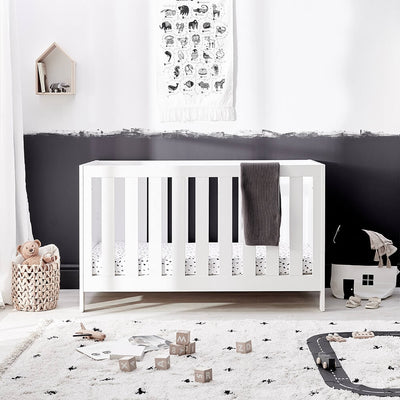
A cot is where your baby will move once they've outgrown a Moses basket or bedside crib, and you can use one right from the start if it fits in your room.
Cot or cot bed?
A cot bed has removable sides and ends, so it converts into a toddler bed later. A standard cot is usually smaller, which can make it easier to fit in your bedroom while you're sharing a room. Cots are typically about 120 x 60cm and cot beds about 140 x 70cm, but sizes vary, so check the label and measure your room before you buy.
What to check on a cot
- Safety standard: look for BS EN 716 in the instructions or on the cot; a cot bed should also meet BS 8509 for its bed mode.
- Bars: smooth, securely fixed and no more than 6.5cm (2.5in) apart.
- Mattress fit: the mattress should match the cot's size and fit snugly, with no space where your baby's head could get stuck.
- Depth: there should be at least 50cm from the top of the mattress to the top of the sides.
- Sturdy build: the cot should feel solid, and moving parts should work smoothly without trapping fingers or clothes.
- Drop sides: a drop-side cot sold in the UK must lock in the lowered position, and never leave your child unattended with the side down.
- Placement: keep it away from heaters, windows, shelves, pictures, mirrors, cables, curtain and blind cords, and furniture a child could climb.
Take a look at our cots and cot beds, and pair yours with a correctly sized mattress.

Which One Suits Your Home?
None of the three is "better" than the others. You might start with a Moses basket or bedside crib and move to a cot later, or go straight to a cot if it fits in your bedroom. In short:
- Moses basket: light and portable for the first few months; check its limits in the manual.
- Bedside crib: a separate space fixed level with your bed; check it suits your bed and fits with no gap.
- Cot or cot bed: larger and longer-lasting, and usable from day one if you have the room; check your room size and mattress fit.

Room-Sharing and Bed-Sharing
Room-sharing means your baby sleeps in their own cot or Moses basket in your room. Bed-sharing means they sleep in your bed. It's always safer for your baby to sleep in their own cot or Moses basket in your room, but there may be times when you end up sharing a bed, so it helps to know how to make it safer.
A cuddle in your bed is lovely, but it's safest to put your baby back in their own cot before you go to sleep.
Never share a bed with your baby if:
- you or your partner have taken medicine that makes you drowsy
- your baby was premature (born before 37 weeks) or had a low birthweight (under 2.5kg or 5.5lb)
You should also avoid sharing a bed if you're extremely tired, or if your baby has a fever or any signs of illness.
If you do share a bed
- Firm and flat: use a firm, flat mattress, with your baby on their back.
- Bedding away: keep pillows, sheets and blankets away from your baby; a baby sleeping bag is safer.
- Just you: no other children or pets in the bed.
- Never alone: never leave your baby alone in an adult bed.
- No gaps: make sure your baby can't fall out or get trapped between the mattress and the wall.
- No swaddling: don't swaddle your baby when sharing a bed.
One more, and it's a big one: never sleep on a sofa or armchair with your baby. Falling asleep with your baby on a sofa or chair can greatly increase the risk of SIDS, and the gaps and cushions can cause suffocation.

When to Move On
Product limits come from the brand rather than a set age, so check your manual for the limits and milestones of your model. As a general guide:
- Moses basket: once your baby outgrows it, move them to a cot or cot bed.
- Bedside crib: several brands say to stop once your baby can sit, kneel or pull themselves up, then move to a cot.
- Cot: lower the base to its lowest position as soon as your baby can sit up unaided, and stop using it as a cot once they can climb out.
- Your room: keep your baby in your room for at least the first 6 months.

What to Check When Buying
Safety standards to look for
- Cot: BS EN 716.
- Bedside crib: BS EN 1130.
- Crib mattress: BS EN 16890.
- Sleeping bag: BS EN 16781.
Before you buy
- Read the label: read labels, safety warnings and instructions, and look for CE or UKCA marking where appropriate.
- Clear information: be cautious of any product with no clear safety information.
- Sleeping bag fit: look for arm holes, no hood and a good fit, so your baby can't slip down inside.
- All parts present: don't use a product if any part is broken, torn or missing, and use only the brand's own spare parts.
What you'll need alongside it
The newborn basics are simple:
- A firm, flat mattress: that fits snugly, with no gaps.
- A waterproof cover: a waterproof mattress protector over the mattress.
- Fitted sheets: at least four cot and crib sheets.
- Sleeping bags or blankets: two baby sleeping bags, or sheets and a cellular baby blanket.
- No duvets or pillows: leave these out of the sleep space altogether.

Our Advice
If we could pass on one thing, it's to start with your bedroom rather than the product. Measure the space beside your bed, check your bed's height and type, and then decide whether a Moses basket, bedside crib or cot fits. Whatever you choose, the basics stay the same: a firm, flat mattress and a clear sleep space.
If you'd like to talk it through, you're warmly invited to our showroom in Langtoft, Peterborough, where our experts are on hand to answer your questions. Book an appointment or simply come and look around. We're open Monday to Saturday, 9am to 5pm, closed on Sundays, and there's no pressure at all. If you'd rather browse first, you can see all our cribs and Moses baskets online, and our guide on when to buy a pram can help you plan your other big buys.
Check Before You Buy
Before you buy a Moses basket, bedside crib or cot, check the manual for its limits, milestones and fitting instructions, and make sure it suits your bed and your room.